Overview
Random Topic Generator is a speaking-practice site with a free half and a paid one. The free half does what the name says and needs no account: it draws 1, 3 or 5 topics from a library of 250 prompts in eight languages, filtered by everyday, work, creative or opinion, and pairs each pick with a one-, two-, three- or five-minute timer while the browser records you. The paid half is the AI report: upload the recording and get a transcript, a native-speaker rewrite, grammar corrections with explanations, pronunciation and clarity notes, filler-word counts, pacing and pauses, and tone - scored on six weighted dimensions (grammar 20, coherence 20, vocabulary 15, fluency 20, filler words 10, confidence) at 100 credits, about $1, per run. Topics can also be generated from a custom request after signing in with Google. The site runs two further free generators behind the same login - YouTube tags and job titles - and eight locale mirrors of the whole thing. Pricing is unusually coherent: the monthly plans, the one-time packs and the per-analysis credit cost reconcile to the same ~$1 on the pricing page, the Chinese mirror and the shipped plan config. The documents are the weak half - the Privacy Policy and Terms both say the service requires sign-in and offers no anonymous access, which is the opposite of how the free tier ships, and a recurring subscription is sold with no refund policy published anywhere.
Key features
- Free draw of 1, 3 or 5 random topics from a 250-topic library, filterable by everyday, work, creative or opinion, with no account
- Eight topic-library languages - English, Chinese, French, Indonesian, Arabic, Turkish, Thai, Hindi - independent of the site's own interface language
- Built-in timer at 1, 2, 3 or 5 minutes with a copy-topic shortcut, so the draw, the pick and the clock are one screen
- Custom AI topics after Google sign-in: describe the audience or difficulty and get 3, 5 or 10 generated topics, unlimited
- AI speech report from a recording: transcript, native rewrite, grammar corrections with original-vs-corrected wording and an explanation for each
- Pronunciation and clarity notes at word level, filler-word counts (um, uh, like, you know, and the equivalents in other languages), pacing, pauses and tone
- Six-dimension score with published weights: grammar 20%, coherence 20%, vocabulary 15%, fluency 20%, filler words 10%, confidence
- Practice history with cloud storage of recordings once signed in, playback and download, plus per-session delete and whole-account delete
- Two extra free generators on the same account - YouTube tags and job titles, both login-gated to limit abuse
Trial checklist
['Start with the free loop and nothing else: draw 5 topics, pick one, run the one-minute timer. If that part is all you need, you never touch the paid side', 'Before paying, decide whether you want one analysis or a habit - a $5 pack is about 5 runs at 100 credits each, so a single test report costs less than any subscription', "Pay through the pricing page only after signing in, and check the plan you actually want: Standard is 2,000 credits (about 20 analyses) and Pro 6,000 (about 60), both monthly with cancellation stated as 'cancel anytime'", 'Ask the vendor in writing for the refund terms before subscribing - no refund policy is published, and the Terms only point at one that 404s', 'Run one real practice session with your own speech, not the example report on the homepage, and read the grammar section against what you actually said before judging the analysis', 'Check whether the ad slots and the analytics tag are acceptable to you on a paid product - both load on every page, including the legal pages, and neither is named in the privacy policy', 'Keep your own copy of the recording if it matters: the policy states no retention period, so what happens to cloud-saved recordings after you stop using the account is not documented']
Pricing
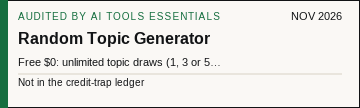
Current official summary: Free $0: unlimited topic draws (1, 3 or 5 from a 250-topic library in 8 languages), the 1/2/3/5-minute timer and local recording, no account, no credits, no AI report. Standard $19.9/month for 2,000 credits/month; Pro $59.9/month for 6,000 credits/month; both 'valid for the current month; cancel anytime'. One-time packs, 'one-time payment, no auto-renewal': $5.00/500 credits, $10.00/1,000 credits, $20.00/2,000 credits. AI analysis costs 100 credits a run, so $5 is about 5 analyses and the $10 card itself says 'Up to 10 AI analyses (100 credits each)'; Standard is about 20 a month and Pro about 60, i.e. roughly $1 an analysis on every path. Stripe for card payments, USD. Verified 2026-11-14 on https://randomtopicgenerator.net/pricing, restated identically on https://randomtopicgenerator.net/zh/pricing (the only two price figures on the Chinese mirror are the same 19.9 and 59.9), and confirmed in the shipped app bundle, where PLANS carries standard {creditsPerMonth: 2000, priceMonthly: 19.9, stripePriceIdEnvKey: 'STRIPE_PRICE_STANDARD'} and pro {creditsPerMonth: 6000, priceMonthly: 59.9, stripePriceIdEnvKey: 'STRIPE_PRICE_PRO'}.
Submitted via form by the vendor 2026-11-15 01:06 UTC (FormSubmit, contact [personal address withheld], category claimed 'Creative', pricing_url and docs_url both blank); editorial entry written independently from live pages on the site's Pacific working date 2026-11-14. Product verified live: /, /pricing, /privacy, /terms, /zh, /zh/pricing, /tags-generator-for-youtube all HTTP 200; /about, /contact, /faq, /docs, /rights, /privacy-policy, /terms-of-service, /refund-policy, /refunds, /refund, /affiliates, /partners, /affiliate, /referral all 404 and /llms.txt returns HTTP 500. robots.txt allows all except /api/ and lists the sitemap; sitemap.xml holds 90 URLs across 8 locales. Free-vs-paid boundary read from the served FAQ set (more than 20 answers say drawing, the timer and local recording need no account) and confirmed against the API surface in the shipped chunks: the only topic endpoint is /api/generate-topics for custom AI topics, alongside /api/auth, /api/me, /api/practice-sessions, /api/recordings/{upload-url,complete,analyze} and /api/payments/confirmed - the free draw is a bundled library, not a metered call. Checkout itself was not exercised (no account created); the Stripe price keys and plan objects are present in the bundle. Third-party surfaces: GA4 G-YF4MWZQVJH (googletagmanager/gid script) and Google AdSense ca-pub-2056450288679377 on every fetched page including /privacy and /terms; no GTM container, Plausible, PostHog, Umami, Clarity or Meta pixel (the 'clarity' string hits are the word in the pronunciation-feedback copy). Contact route probed without sending: MX is Cloudflare Email Routing (route1/2/3), and a live SMTP RCPT TO split shows contact@randomtopicgenerator.net accepts (250 2.1.0 Ok) while a random local part rejects (550 5.1.1 Address does not exist), so the domain carries one real, deliverable mailbox rather than a catch-all. RDAP: randomtopicgenerator.net registered 2026-02-21T10:21:23Z via Cloudflare, NS coby/susan.ns.cloudflare.com - the same NS pair and the same submitting Gmail address as protocolexplorer.org, which this ledger holds on a catalogue-scope question, so this is a second product from one operator rather than a stranger. Name market checked by RDAP and fetch: randomtopicgenerator.org (registered 2024-09-16, Dreamhost NS) is a live unrelated free tool under the same descriptive name; random-topic-generator.com and speechtopicgen.com sell the same concept; randomtopicgenerator.com is an Afternic parked lander with no product. Third-party footprint: directory listings on poweredbyai.app and arintoo.com only - no independent review or user report, so hands_on_status stays not_tested.
Pricing changes often, verify current plans on the official site before buying. Dated snapshots: Pricing Watch.
Use cases
- A one-minute impromptu warm-up before a meeting, with a fresh topic each time and no sign-up
- Classroom or club Table Topics practice where the teacher draws 3 or 5 topics and the group picks
- English speaking practice in your own language pair - the library covers eight languages, including Arabic, Hindi and Thai
- Getting a written diagnosis of filler words and pacing after a practice run, when a coach is not available
- Comparing what you said against a polished rewrite of the same speech to see the gap
- Timed rehearsal for a work presentation in 2- or 3-minute blocks
Pros
- The free tier is real and costs the operator nothing to serve: the topic draw, categories and timer run in the browser from a bundled library, the only topic API being the custom-AI path, so 'free, no sign-up' is a product fact rather than a trial
- Pricing reconciles three ways - the pricing page, the /zh mirror and the shipped plan config (2,000 credits at $19.9, 6,000 at $59.9, packs 500/$5, 1,000/$10, 2,000/$20, 100 credits per analysis) all land on about $1 an analysis
- Processors are named by company where plenty of listings in this catalogue name none: OpenRouter and the providers behind it for topics and recordings, Stripe for payments, Google for sign-in
- The report is specified rather than hyped - six dimensions with their weights (grammar 20, coherence 20, vocabulary 15, fluency 20, fillers 10, confidence) and the rule behind each score, so a reader knows what they are buying
- A written limit on use of the recording: 'We do not use your recordings for any purpose other than delivering the analysis and related services to you'
- Deletion is built into the product, not just promised: a practice session can be deleted individually and the account page describes deleting the account as permanent, removing credits, practice history and subscriptions
- The FAQ answers are unusually concrete about the boundary between free and paid - what needs an account, what does not, and that free accounts cannot run the AI report
Cons
- The Privacy Policy and the Terms both open by saying the service 'requires sign-in with Google to use the service; we do not offer anonymous access', while the homepage, the pricing page and more than twenty FAQ answers say drawing topics and using the timer are free with no account - the legal copy describes a different access model than the product actually ships
- No refund policy exists anywhere: /refund, /refunds, /refund-policy and /refund-terms all return 404, yet the Terms say 'Cancellation and refunds are handled according to your plan and our policy' and 'you agree to our subscription and refund terms' - a recurring subscription is sold against a document that is not published
- No company, trading name, postal address, controller or country appears on any page, the footer is a bare '©' with no name and no year, neither legal page carries an effective or updated date, and the Terms have no governing-law clause at all
- Google Analytics 4 (G-YF4MWZQVJH) and Google AdSense (ca-pub-2056450288679377) load on every page including /privacy and /terms, and the policy names neither - it mentions only cookies 'for sign-in and basic site function'. Purchase and checkout-return events are pushed to the analytics tag from the app bundle, and ads run on the pages of a paid product
- No retention period is stated for recordings, transcripts or reports - only 'private, access-controlled storage' associated with the account, with no stated deletion schedule
- Training use is neither clearly granted nor withheld for the third-party providers: the policy limits the operator's own use of recordings and then defers processing to OpenRouter and 'that provider's own privacy and data processing policies'
- /llms.txt returns HTTP 500 while the rest of the site serves normally - a broken discovery route rather than a missing page
- The name is descriptive and crowded: an unrelated free tool has run at randomtopicgenerator.org since 2024 with its own AI topic generator, and random-topic-generator.com, speechtopicgen.com and talkdrill.com use the same phrasing. No relationship to this site is claimed or denied, so a reader searching the name may land on a competitor
- The '40+ languages' claim for the AI report is the vendor's own and could not be checked without an account; the eight topic-library languages are the ones the site itself enumerates
- Outside footprint is directory listings (poweredbyai.app, arintoo.com) with no independent review, hands-on test or user report to check the analysis quality against
Who Random Topic Generator is for
Random Topic Generator is aimed at teams and individuals who need people practising impromptu speaking on their own terms - language learners, teachers running a class warm-up, toastmasters-style clubs, and anyone who wants to talk for one minute without freezing. the free path needs no account: draw 1, 3 or 5 topics from a 250-topic library in eight languages, pick a 1/2/3/5-minute timer, and record locally. the paid path is only for the ai speech report, which costs 100 credits a run (about $1 on every pack and plan), so it fits someone who wants grammar, filler-word and pacing feedback and is willing to pay per analysis. it is not a fit if you need a named company, a governing-law clause or a published refund term before you subscribe, if you object to ad-supported pages on a paid product, or if you want a human coach - the report is model output scored on six fixed dimensions. It is designed for education workflows where output quality, adoption effort, and operating cost all matter. Compare alternatives first if you require self-hosting, unusually deep customization, or tighter policy controls than the official plan provides.
Buying decision
| Keep it when | People practising impromptu speaking on their own terms - language learners, teachers running a class warm-up, Toastmasters-style clubs, and anyone who wants to talk for one minute without freezing. The free path needs no account: draw 1, 3 or 5 topics from a 250-topic library in eight languages, pick a 1/2/3/5-minute timer, and record locally. The paid path is only for the AI speech report, which costs 100 credits a run (about $1 on every pack and plan), so it fits someone who wants grammar, filler-word and pacing feedback and is willing to pay per analysis. It is not a fit if you need a named company, a governing-law clause or a published refund term before you subscribe, if you object to ad-supported pages on a paid product, or if you want a human coach - the report is model output scored on six fixed dimensions. is the job you repeat. |
|---|---|
| Test first when | The Privacy Policy and the Terms both open by saying the service 'requires sign-in with Google to use the service; we do not offer anonymous access', while the homepage, the pricing page and more than twenty FAQ answers say drawing topics and using the timer are free with no account - the legal copy describes a different access model than the product actually ships. |
| Before you pay | Run the trial checklist and check the current plan limit on the official pricing page. |
Verdict
The call: Random Topic Generator. The free tier is real and costs the operator nothing to serve: the topic draw, categories and timer run in the browser from a bundled library, the only topic API being the custom-AI path, so 'free, no sign-up' is a product fact rather than a trial. Price this before you renew: the privacy policy and the terms both open by saying the service 'requires sign-in with google to use the service; we do not offer anonymous access', while the homepage, the pricing page and more than twenty faq answers say drawing topics and using the timer are free with no account - the legal copy describes a different access model than the product actually ships.
Run one real task from your work this week. That tells you more than this review.
How Random Topic Generator compares
In education, Random Topic Generator sits next to AILearnHub, Khanmigo, MagicSchool. The useful part is the free tier is real and costs the operator nothing to serve: the topic draw, categories and timer run in the browser from a bundled library, the only topic api being the custom-ai path, so 'free, no sign-up' is a product fact rather than a trial. The part to price first is the privacy policy and the terms both open by saying the service 'requires sign-in with google to use the service; we do not offer anonymous access', while the homepage, the pricing page and more than twenty faq answers say drawing topics and using the timer are free with no account - the legal copy describes a different access model than the product actually ships. Read the side-by-side before you pay for a second seat.
How we evaluated
We don't publish an editorial score until we have tested a tool hands-on, and we have not tested Random Topic Generator yet. This review uses the vendor's published pricing and documentation, benchmark data where the exact model is identifiable, and the trial checklist above. See how we review, the evidence log, and our benchmark policy.
Frequently asked questions
Is Random Topic Generator free?
Yes, for the part most people use. Drawing 1, 3 or 5 topics from the 250-topic library, the categories, the 1/2/3/5-minute timer and local recording are free, unlimited and need no account. What costs money is the AI speech report - 100 credits a run, about $1 - which needs a Google sign-in plus either a subscription ($19.9 a month for 2,000 credits, $59.9 for 6,000) or a one-time pack ($5 for 500 credits, $10 for 1,000, $20 for 2,000).
Do I need to create an account to practise speaking?
Not for the free loop. The site draws topics and runs the timer without an account, and the recording stays on your device. A Google account is needed for three things: custom AI-generated topics, saving recordings to practice history in the cloud, and the AI report. Note that the Privacy Policy and Terms currently say the opposite - that the service requires sign-in and offers no anonymous access - which we read as out-of-date legal copy rather than the shipped behaviour, and have asked the vendor about.
What does the AI speech report actually score?
Six weighted dimensions: grammar 20% (tense, agreement, articles, word choice), coherence 20% (thesis, structure, transitions), vocabulary 15% (diversity and register), fluency 20% (pacing and mid-sentence hesitation), filler words 10% (every um, uh, like and you know, with roughly five points off per filler per minute) and confidence. Alongside the score you get the transcript, a native rewrite, per-error grammar notes, word-level pronunciation tips, and pacing, pause and tone commentary.
Is my recording used to train models?
The policy commits that the operator does not use your recordings for anything other than delivering the analysis, and that recordings sit in private storage tied to your account. What it does not settle is provider-side use: processing is sent to OpenRouter and its underlying providers under their own terms, and there is no separate statement on training for that leg. You can delete a session, or the whole account, from inside the product.
Cite or embed this audit
The badge links to this review. It is a dated price receipt, not a ranking and not a paid placement.