Overview
Reply Argus connects to App Store Connect and Google Play, pulls every review from both stores into one inbox, and drafts a reply in the reviewer's own language - 100+ languages, drawn from the app's own store listings, marketing page, past approved replies and any notes you add, with the cited lines shown so a draft can't invent a refund or a ship date. Nothing posts until you approve it; auto-publish is opt-in and can be scoped by rating, keyword, language or store, and on Pro and up a rules engine handles that. Alongside the inbox it clusters duplicated complaints with a match score and ranks recurring asks into a 'Signal' feed that can be exported to Notion or Sheets as a roadmap. Pricing is per reply volume rather than per seat: Indie $9.99/mo (4 apps, 300 replies), Pro $19.99/mo (10 apps, 2,000 replies, API and webhooks), Studio $99/mo (30 apps, 8,000 replies, white-label), each with a 14-day trial and a card at signup. For teams that want the queue inside an agent, /api/mcp is a remote MCP server signed in over OAuth, and /api/v1 exposes read-only apps and reviews with signed webhooks. The gaps a buyer should know about are documentary: no company, address or governing law anywhere on the site, no refund policy page, unnamed AI providers, and a signup page that advertises a free plan the pricing page denies.
Key features
- One inbox for App Store and Google Play reviews, with statuses of New, Drafted, Published and Skipped and per-app isolation
- Grounded draft replies in 100+ languages, citing the store listing, marketing page, notes and past approved replies used, with contradiction flags between sources
- Approval-first publishing: auto-publish off by default, optional for 5-star replies, or rule-scoped by rating, keyword, language or store
- Find-similar clustering with a match score, so one reply pattern can answer a theme instead of a single review
- Signal: recurring asks ranked by what to fix, each linked to the reviews behind it, exportable to Notion or Sheets (Jira and DevRev listed as soon)
- Analytics with rating trend, response rate and an AI summary naming the themes behind a change
- Remote MCP server at /api/mcp, OAuth sign-in, one-click for Cursor and Claude Desktop, CLI for Claude Code and Codex
- Read-only REST API (/api/v1/apps, /api/v1/reviews) with keyset pagination and HMAC-signed webhooks for review.created, draft.created, reply.published, digest.weekly and anomaly.detected
- Alerts to Slack, Telegram, Discord, email or a webhook, including rating-drop and review-spike triggers
- White-label on Studio: your logo, product name and sending domain, with roll-up analytics across a client portfolio
Trial checklist
["Before paying: ask support which free tier exists. The signup page promises 'Free for 1 app and 100 replies a month. You don't need a card' while the pricing FAQ says there is no free plan and the card is taken at signup - the answer decides whether you are trialling or subscribing", 'Connect one app you actually ship and read the first ten drafts against the reviews they answer: the grounded draft shows the listing and note lines it used, so check that those lines are real and that no refund, fix date or feature it states is invented', "Set approval mode and leave auto-publish off for the first two weeks; then, if you enable it, scope it to 5-star replies only. Both stores allow one public reply per review and Play's reply cannot be deleted", 'Test the reply language on your worst market rather than English: paste a review in the language you actually receive and check tone and formality, not just vocabulary', 'Check the review-sync window on both stores at the start of the trial - neither store backfills everything, and the 7-day reply window means an old review may already be unanswerable', 'Use Signal on a real month and export it once to Notion or Sheets; if the ranked list does not match the complaints you already know about, the clustering is not earning its place in your workflow', 'Before day 14, decide on the yearly price against monthly: $99.90 vs $119.88 on Indie is a real saving but a twelve-month commitment to a company that names no legal entity and publishes no refund policy']
Use category-specific evidence
SWE-bench Verified [3] ↗ · Terminal-Bench leaderboard (frozen 2.1 URL now serves 4.1) [6] ↗ · LiveBench [4] ↗ · Artificial Analysis methodology [5] ↗
Benchmark numbers are evidence for a specific task and configuration, not a universal product score. See benchmark policy →
Pricing
Current official summary: No self-serve free plan is published on /pricing, which sells three monthly-or-yearly plans and Enterprise: Indie $9.99/mo or $99.90/yr ($8.33/mo billed annually) with 4 active apps and 300 replies/mo; Pro $19.99/mo or $199.90/yr ($16.66/mo) with 10 active apps and 2,000 replies, adding automation rules, auto-translate, analytics, the public REST API and signed webhooks; Studio $99/mo or $990/yr ($82.50/mo) with 30 active apps and 8,000 replies, white-label sending domain and per-app isolation; Enterprise custom. Every plan starts with a 14-day free trial and the card is required at signup: the pricing FAQ answers 'You add a card to begin, but nothing is charged until day 14'. Seats are included rather than sold (5 / 10 / 25 / unlimited) and viewers are free; the FAQ states 'You're never billed for overage'. Yearly billing is exactly ten months of the monthly price (2 months free), so 9.99x10 = 99.90, 19.99x10 = 199.90 and 99x10 = 990 all reconcile. The same three prices appear in /llms.txt, /llms-full.txt and the pricing page's JSON-LD Offer array. Two add-ons are described in the Terms (extra active-app slots billed on the regular cycle, and prepaid reply top-up packs that do not expire) but neither carries a price on /pricing. The vendor contradicts this on its own signup and login pages, which read 'Free for 1 app and 100 replies a month. You don't need a card', and the pricing FAQ answers 'Is there a free plan? No'. No purchase or trial was started; billing is by Dodo Payments as merchant of record.
Open verification questions
- Whether a free plan exists: /signup and /login say 'Free for 1 app and 100 replies a month. You don't need a card', while /pricing and /llms-full.txt answer 'Is there a free plan? No' and require a card for the 14-day trial.
- The legal entity, registered address, named controller and governing law are stated nowhere on the site; the only contact route is support@replyargus.com.
- The AI providers that process review text and knowledge-base documents are unnamed, though the policy asserts they are contractually barred from training on it.
- Retention after cancellation is specified as 'a short window' with no number of days.
- No refund or cancellation policy page exists, and the Terms state only that trials convert and plans bill in advance.
- Homepage traction figures (1,010+ replies across 350+ apps; a this-week 82/61/94% panel) cannot be verified from outside, and the five app avatars are not linked to store listings.
- Extra active-app slots and reply top-up packs are sold per the Terms but carry no published price.
- Stale third-party mirrors (launchscaler.com and a cached homepage snippet) still describe a $29/$79 ladder and a free 100-reply plan that the live pages no longer sell.
Submitted via form by the vendor on 2026-11-18 20:24 UTC (2026-11-18 in the site's Pacific working day; contact [personal address withheld], a masked forwarding address on a domain with MX but no A record, category claimed 'Other', pricing_url and docs_url both left blank); editorial entry written independently and the submitted summary was not used for any fact. Read live on 2026-11-18 with a browser user agent: / (200 after a 308 to www), /pricing, /about, /features, /integrations, /api, /agentic-tools, /signup, /login, /blog, /benchmarks/app-reply-rates, /tools/review-reply-generator, /alternatives, /legal/privacy, /legal/terms, /security, /llms.txt, /llms-full.txt, /sitemap.xml and /.well-known/security.txt. /contact, /legal/refund, /refund-policy, /legal/cookies, /legal/subprocessors and /legal/security all 404. Pricing was taken from four agreeing surfaces: the /pricing cards, /llms.txt, /llms-full.txt and the JSON-LD Offer array (9.99 / 19.99 / 99 USD), and the yearly figures reconcile as ten monthly payments. The category was set to Development rather than the submitted 'Other' because the product is developer-facing app-store review operations with a REST API and an MCP server. Liveness evidence without an account: /api/mcp, /api/v1/apps and several adjacent /api paths all answer 401 with an OAuth-style body, and DNS publishes a 'v=MCPv1' TXT record. No account, trial or purchase was started; checkout is Dodo Payments as merchant of record and its index page (index.dodopayments.com/replyargus) sits behind a Vercel security checkpoint that could not be read without a browser. Domain registered 2026-07-02 (Cloudflare NS adrian/lee, MX smtp.google.com); no name collision - 'Reply Argus' is distinct from Argus Media, Bosch's Argus surveillance suite and the Argus fitness app, and no other live product trades under this name. Third-party pages still describe an earlier $29/$79 ladder and a 100-reply free plan (launchscaler.com review; a cached search snippet of the homepage); the live pages fetched today sell 9.99/19.99/99, so those were recorded as stale mirrors rather than as vendor contradictions and are not in the listing.
Pricing changes often, verify current plans on the official site before buying. Dated snapshots: Pricing Watch.
Use cases
- Answering every App Store and Google Play review in the language it was written in, without a translator or a template library
- Keeping a 1-star from sitting unanswered overnight - a shared inbox for both stores with drafts waiting on approval
- Turning repeated complaints into a ranked fix list (Signal) and exporting it to Notion or Sheets as a product roadmap
- Running reviews for a portfolio of apps or client apps, each with its own voice, rules and knowledge base
- Letting a Claude, Cursor or Codex agent triage and draft replies over MCP with publishing still gated on approval
- Pulling reviews and replies into your own tooling through the read-only REST API and signed webhooks
Pros
- The prices are the same three numbers on four independent surfaces - /pricing, /llms.txt, /llms-full.txt and the page's own JSON-LD Offer array - and the yearly figure is exactly ten monthly payments, so the '2 months free' line is arithmetic rather than a claim
- Seats are bundled on every plan (5 / 10 / 25 / unlimited) and viewers are free, with the FAQ stating 'You're never billed for overage': usage is bounded by pausing drafting when the reply allowance runs out, not by an automatic upcharge
- The approval gate is the default, not an option: auto-publish is off until you enable it and can be limited to 5-star replies or scoped by rating, keyword, language or store on Pro and up - which matters because both stores allow exactly one public reply per review
- Grounding is shown rather than asserted: a draft displays the store-listing lines and notes it drew on, and the product flags contradictions between the app's own sources before they reach a public reply
- Privacy names its processors with the job each does - Supabase (database and auth), Vercel (hosting), Jina AI (page text extraction), Resend (transactional email), Dodo Payments (billing), PostHog and Google Ads for optional analytics - and states that review text is not used to train shared models
- Cookie handling is described precisely rather than gestured at: strictly-necessary cookies, analytics loaded only after consent in the EU/EEA/UK/Switzerland, a footer 'Cookie settings' control, a named ra_consent cookie with a six-month life and a one-day ra_geo region cookie
- The published benchmark is a real artifact, not a marketing stat: 36 named apps, 300 reviews each (10,800 total), collected 26 July 2026, with a stated method, exclusions and the pooled-versus-median gap (18.3% pooled, 1.2% median) explained rather than hidden
- The developer surface exists and is checkable: /api/v1/apps and /api/v1/reviews answer with an auth challenge, webhooks are HMAC-signed with named events, /api/mcp is OAuth rather than API-key, and /.well-known/security.txt and a v=MCPv1 DNS TXT record are both published
- Documentation of the platform constraints is unusually good for a young product - the App Store Connect and Google Play reviews API references cover the 7-day window, the ~350-character Play cap, the 200/hr and 2,000/day quotas, and the fact that neither store sends a webhook
- Card data never reaches their servers (Dodo Payments is the merchant of record), and the security page invites independent scanning (Qualys SSL Labs, MDN HTTP Observatory, SecurityHeaders) instead of asking to be taken on trust
- A free, no-account reply generator and calculators sit in front of the paid product, so a reader can see the drafting quality without a card
Cons
- No company is named anywhere on the site. The Privacy Policy and Terms both define the counterparty only as '"Reply Argus," "we," "us" or "our"', the only address published is support@replyargus.com, and there is no registered office, company number or named controller - so a buyer cannot tell which legal person they are contracting with
- No governing-law or jurisdiction clause exists in the Terms, whose six short sections cover accounts, acceptable use, approvals, billing, availability and changes but omit liability, indemnity, termination, refunds, age limits and dispute resolution
- The signup and login pages advertise a free plan the pricing page denies: both read 'Free for 1 app and 100 replies a month. You don't need a card' and 'Every plan starts with a 14-day free trial', while the pricing FAQ answers 'Is there a free plan? No, but every plan starts with a 14-day free trial. You add a card to begin' - a reader cannot tell whether they are signing up to a card-free tier or a card-required trial
- There is no refund or cancellation policy page: /legal/refund, /refund-policy, /legal/cookies and /legal/subprocessors all return 404. The Terms say trials convert to paid, that plans bill in advance and that downgrades take effect at cycle end, but nothing states a refund position - and the refund/cancellation terms sit with Dodo Payments as merchant of record
- The AI providers that read every review and knowledge-base document are unnamed ('our AI providers (draft and analyze replies)'); the policy says business customers can request the list naming each one by email, which is a weaker disclosure than naming them on the page
- Retention is a phrase rather than a period: review and reply history is kept 'for as long as your account is active, plus a short window after cancellation so you can reactivate. Then it's deleted' - no number of days, and no stated period for logs or backups
- The Terms are dated 1 July 2026, one day before the domain's own registration date of 2 July 2026, and the Privacy Policy 25 August 2026 - worth asking whether the earliest date is authoritative or carried over from a template
- Homepage traction figures are unverifiable from outside: '1,010+ replies drafted across 350+ apps', a 'This week' panel reading 'Drafted 82 / Published 61 / avg reply 2m18s' and a '94%' response rate, with five app avatars (Parasocial, Retrograde, Woogie, Egg Notes, Truth or Dare) that are not linked to store listings
- Two paid add-ons are described in the Terms - extra active-app slots billed on your regular cycle and prepaid reply top-up packs - but neither appears with a price on /pricing, so the cost of growing past a plan is not knowable before signup
- The footer 'Contact' link is a mailto to support@replyargus.com only: /contact returns 404, so there is no contact page, postal address or company-detail page to fall back on
Who Reply Argus is for
Reply Argus is aimed at teams and individuals who need ios and android developers, app studios and agencies who would rather answer app store and google play reviews in the reviewer's own language than paste the same english template at every 1-star - especially teams that want an approval gate before anything posts to a store, and developers who want the review queue reachable from an ai agent over mcp or from their own read-only rest integration. It is designed for development workflows where output quality, adoption effort, and operating cost all matter. Compare alternatives first if you require self-hosting, unusually deep customization, or tighter policy controls than the official plan provides.
Buying decision
| Keep it when | iOS and Android developers, app studios and agencies who would rather answer App Store and Google Play reviews in the reviewer's own language than paste the same English template at every 1-star - especially teams that want an approval gate before anything posts to a store, and developers who want the review queue reachable from an AI agent over MCP or from their own read-only REST integration is the job you repeat. |
|---|---|
| Test first when | No company is named anywhere on the site. The Privacy Policy and Terms both define the counterparty only as '"Reply Argus," "we," "us" or "our"', the only address published is support@replyargus.com, and there is no registered office, company number or named controller - so a buyer cannot tell which legal person they are contracting with. |
| Before you pay | Run the trial checklist and check the current plan limit on the official pricing page. |
Verdict
The call: Reply Argus. The prices are the same three numbers on four independent surfaces - /pricing, /llms.txt, /llms-full.txt and the page's own JSON-LD Offer array - and the yearly figure is exactly ten monthly payments, so the '2 months free' line is arithmetic rather than a claim. Price this before you renew: no company is named anywhere on the site. the privacy policy and terms both define the counterparty only as '"reply argus," "we," "us" or "our"', the only address published is support@replyargus.com, and there is no registered office, company number or named controller - so a buyer cannot tell which legal person they are contracting with.
Run one real task from your work this week. That tells you more than this review.
How Reply Argus compares
In development, Reply Argus sits next to Bolt.new, CCC (Claude Command Center), Cursor and 5 others. The useful part is the prices are the same three numbers on four independent surfaces - /pricing, /llms.txt, /llms-full.txt and the page's own json-ld offer array - and the yearly figure is exactly ten monthly payments, so the '2 months free' line is arithmetic rather than a claim. The part to price first is no company is named anywhere on the site. the privacy policy and terms both define the counterparty only as '"reply argus," "we," "us" or "our"', the only address published is support@replyargus.com, and there is no registered office, company number or named controller - so a buyer cannot tell which legal person they are contracting with. Read the side-by-side before you pay for a second seat.
How we evaluated
We don't publish an editorial score until we have tested a tool hands-on, and we have not tested Reply Argus yet. This review uses the vendor's published pricing and documentation, benchmark data where the exact model is identifiable, and the trial checklist above. See how we review, the evidence log, and our benchmark policy.
Frequently asked questions
What does Reply Argus cost?
Indie is $9.99 a month or $99.90 a year for 4 active apps and 300 replies a month; Pro is $19.99 or $199.90 for 10 apps and 2,000 replies plus automation rules, the REST API and webhooks; Studio is $99 or $990 for 30 apps and 8,000 replies with white-label and per-app isolation; Enterprise is custom. Every plan carries a 14-day trial with a card at signup, billed from day 14, and the yearly price is exactly ten monthly payments. Two caveats: the signup and login pages advertise a card-free free plan ('Free for 1 app and 100 replies a month') that /pricing answers with 'Is there a free plan? No', and the extra-app-slot and reply-top-up add-ons described in the Terms carry no published price.
Does it post replies without approval?
No, not unless you turn that on. Approval mode is the default and auto-publish is opt-in, limited to 5-star replies if you want the narrowest rule, or scoped by rating, keyword, language or store on Pro and up. That default matters because both stores allow exactly one public reply per review and Google Play exposes no delete method - the vendor's own reference pages document both constraints.
Which stores does it cover, and what does it need from them?
Apple's App Store and Google Play only - no Microsoft Store, Steam or web stores. You connect App Store Connect and the Play Console once and it polls both, because neither store pushes a webhook for a new review. The vendor's API references put the practical limits at roughly 350 characters per Play reply and the 7-day reply window on both platforms.
Who is behind it, and where is the company?
Nothing on the site says. There is no company name, no registered address, no company number and no governing-law clause in the Terms, and the only contact route published is support@replyargus.com (the footer 'Contact' link is a mailto and /contact returns 404). The domain was registered on 2 July 2026, the product launched on Product Hunt on 28 July 2026, and the blog is bylined 'The Argus Team'. Ask before paying annually.
Can an AI agent drive it?
Yes - that is a first-class feature rather than an add-on. /api/mcp is a remote MCP server that signs in over OAuth (not an API key) and is scoped to your workspace, with publish calls gated on approval; the site publishes one-click setup for Cursor and Claude Desktop and CLI/TOML snippets for Claude Code and Codex. Separately, Pro and up get a read-only REST API and HMAC-signed webhooks for your own tooling.
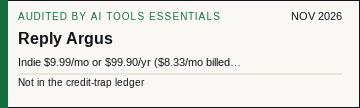
Cite or embed this audit
The badge links to this review. It is a dated price receipt, not a ranking and not a paid placement.