Overview
CCC (Claude Command Center) is a local dashboard for people running several coding agents at once. Instead of owning execution, it reads each engine's on-disk state as the source of truth, so a session you started in a terminal, resumed by hand or launched headless outside the dashboard still shows up on the board - that is the difference between a dashboard and a second place you have to remember to work from. On top of the board it adds a needs-attention lane that flags sessions ending on a real question, a per-session context meter, plan-usage and rate-limit projections, a Kanban with a project tree and an infinite Flow canvas, group chats between agents, a work queue with verify-to-close receipts, git worktrees per task, and an optional fallback that keeps a limit-hit session running on a $0 model. The stack is deliberately plain: a stdlib-only Python server bound to 127.0.0.1 and a no-build vanilla-JS UI, with readable JSON state under ~/.claude/command-center/. Claude Code is first-class; Codex, Cursor, Antigravity, Kilo Code, Kimi Code, OpenCode and Devin spawn and ingest with documented gaps. Version 5.39.0 shipped 2026-10-18 and the repository was pushed the same day this review was written.
Key features
- One local board for every coding-agent session on the machine, read from each engine's on-disk state rather than only from sessions the dashboard spawned
- Needs-attention lane for sessions that end on a real question, including plain-prose ones, with desktop notifications on macOS
- Per-session context meter with warning and danger levels and one-click compact
- Usage windows and rate-limit pace projections for Claude plans and Codex limits
- Optional fallback of a limit-hit session to a local free-model router, with deliberate per-session choice rather than automatic spend
- Kanban stage columns (Working, Review, a testing column, Verified, Archived), a nestable project tree, and an infinite zoomable Flow canvas with edges
- Split pane for two transcripts side by side, each with its own input bar, plus search and ask across session history with citations back to the source session
- Group chats that let several agent sessions share a thread and ping each other in turn, with no orchestrator to write
- Work queue with claim, fix, verify and close lifecycle, a queue-health watcher, and receipts that close GitHub issues with a commit-SHA comment
- One-click fresh git worktrees per task, an annotate mode that turns a clicked element into a queue ticket, and an optional Vercel watch for failed production deploys
- Responsive mobile UI with one-button Tailscale setup and a QR code, or an opt-in outbound-only CCC Cloud relay
- ccc CLI for the fleet from a terminal: sessions, models, spawn, send and ask, with sessions addressable by id or name fragment
- Stdlib-only Python server bound to 127.0.0.1 with a no-build vanilla-JS interface, and human-readable JSON state under ~/.claude/command-center/
Trial checklist
["Install from the notarized DMG or brew install amirfish1/tap/ccc, then chmod 700 ~/.claude/command-center/ before you use it on any machine you share - the vendor's own SECURITY.md says the state files land world-readable by default", 'Decide about the beacon before first launch rather than after: set CCC_TELEMETRY_DISABLED=1 if you want zero wire bytes, then read the payload list in docs/telemetry.md so the decision is based on the contract, not the marketing line', 'Test the central claim first: start a session in a terminal by hand, then open the board and confirm it appears without having been spawned from the dashboard - if hand-started sessions do not show up, the product is not doing the thing it exists for', 'Run one real task end to end and wait for the needs-attention lane to fire on a plain-prose question; that detection, not the Kanban, is what saves the wasted afternoon', 'Read every Agent config change in the consent dialog before approving it: CCC writes hooks into ~/.claude/settings.json and ~/.codex/hooks.json to get the sidecar state it reads, and it asks per change', 'Do not expose the port. There is no authentication; if you want it on your phone, use the Tailscale path or the outbound-only Cloud relay rather than binding 0.0.0.0', "Keep the free-model fallback deliberate - choose '$0 Free' per session instead of setting 'Always' - so a limit hit cannot quietly route work to a different provider's model", 'Before relying on the work queue overnight, run it once on a scratch repository with three tickets and check that verify actually closes with a commit-SHA receipt rather than a summary']
Use category-specific evidence
SWE-bench Verified [3] ↗ · Terminal-Bench 2.1 leaderboard (frozen; subdomain now serves 4.0) [6] ↗ · LiveBench [4] ↗ · Artificial Analysis methodology [5] ↗
Benchmark numbers are evidence for a specific task and configuration, not a universal product score. See benchmark policy →
Pricing
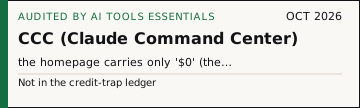
Current official summary: Free. USD 0 with no tiers, no paid plan, no seat count, no trial clock and no account for the local app. Verified by sweeping every served page for price tokens: the homepage carries only '$0' (the free-model choice), and /captain/, /receipts/, /watchtower/, /vs-heavyweight-ides.html and /demo/ carry no price token at all. Check that the product is actually obtainable rather than merely announced: the release asset releases/latest/download/ccc.dmg answers HTTP 200 with content-type application/octet-stream and 3,614,187 bytes, and the Homebrew formula at raw.githubusercontent.com/amirfish1/homebrew-tap/main/Formula/ccc.rb answers 200. License is FSL-1.1-MIT, copyright 2026 Amir Fish: Permitted Purpose use including internal and professional use, no Competing Use, and an irrevocable grant of MIT on the second anniversary of each version's release. GitHub reports the license as NOASSERTION because FSL is not an SPDX-recognised open-source license, which matches the site's own description of itself as source-available. The optional CCC Cloud relay is account-based; its user guide lists no price, so there is no recurring figure to verify.
submitted via form by vendor; editorial entry written independently. Received through FormSubmit on 2026-10-24 20:32 UTC with pricing_url and docs_url both pointing at the GitHub repository and contact_email amir.fish@gmail.com. No privacy_url is recorded because none exists: /privacy, /terms, /privacy.html, /terms.html and /legal/ all 404 on ccc.amirfish.ai, and the parent brand domain amirfish.ai returns 404 for /privacy, /terms, /privacy.html and /terms.html and publishes no sitemap. Product verified by fetching the live site and its subpages (/, /captain/, /receipts/, /watchtower/, /demo/, /vs-heavyweight-ides.html all 200), the repository metadata via the GitHub API (created 2026-04-13, 202 stars, 25 forks, 8 open issues, default branch main, license reported NOASSERTION, pushed the same day as this review) and the raw LICENSE, SECURITY.md, docs/telemetry.md and docs/cloud-relay/SECURITY-AND-PRIVACY.md. The telemetry claim was checked against source (ccc_server/fleet_jobs.py) rather than against the policy page: the payload and the never-sent list are documented in the module, the retired opt-in ping is described in the same comment, and the kill switch is an environment variable. Website analytics were read from the served /analytics.js: PostHog with persistence memory, person_profiles identified_only, and autocapture, pageleave, session replay, surveys, dead clicks, performance, heatmaps and exception capture all disabled, respect_dnt true. Operator identity is a named individual (Amir Fish, copyright holder in the LICENSE) with a personal site at amirfish.ai naming Sunnyvale, California and a LinkedIn profile, plus amir@amirfish.com published there and amir.fish@gmail.com in the submission; the domain amirfish.ai publishes MX (10 inbound-smtp.us-east-1.amazonaws.com), so a domain address is deliverable in principle, but no company entity, postal address or governing-law clause exists. Name collision checked: at least five unrelated GitHub repositories use the same 'claude-command-center' name (nubbymong, Dicoangelo, sorlen008, afstkla, adamclark64) and none is a live incumbent commercial product trading under CCC, so this is a crowded descriptive name rather than a rights dispute. Third-party coverage exists (a YouTube walkthrough, ai-underdog.com, reporank.net, marketgenius.ai, and an entry in andyrewlee/awesome-agent-orchestrators), so the product is not a single unverified page. No hands-on testing was performed: hands_on_status is not_tested and every workflow claim in the listing is attributed to the vendor's own documentation or to the shipped source.
Pricing changes often — verify current plans on the official site before buying. Dated snapshots: Pricing Watch.
Use cases
- Seeing every coding-agent session on one machine, including ones started or resumed by hand in a terminal
- Spotting the agent that asked a question forty minutes ago, or the one whose context window is nearly full
- Arranging a fleet of sessions by stage - Working, Review, a testing column, Verified, Archived - instead of one flat list
- Typing a follow-up into a dormant session from the browser and having it resume to receive it
- Running a queue of tickets overnight with agents that claim, fix, verify and close work with a receipt
- Keeping work going past a plan's usage limit by falling back to a free model, then switching back at reset
- Watching the fleet from a phone over Tailscale rather than exposing a dashboard to the open internet
Pros
- The telemetry claim survives reading the code rather than only the copy: ccc_server/fleet_jobs.py documents the complete beacon payload field by field (schema_version, version, platform, and two booleans derived from the local last-run date), lists what is never sent - no install id, no prompts, transcripts, tool calls, session counts, token counts, repo paths, hostname, git config or IP - and CCC_TELEMETRY_DISABLED=1 is a hard kill switch that stops every byte rather than a preference stored somewhere
- The richer opt-in daily ping was retired on 2026-09-28 and the code says so in the same comment block, with the reason (the consent banner was not worth the number, and active_seconds_today was broken by construction) - a vendor deleting its own telemetry surface and documenting why is rare
- Site analytics are deliberately configured rather than left on defaults: PostHog is initialised with persistence memory, person_profiles identified_only, and autocapture, pageleave, session replay, surveys, dead clicks, performance, heatmaps and exception capture all off, with respect_dnt on, so pageviews and the download button are the whole measurement
- The vendor publishes a threat model instead of a security page of adjectives: SECURITY.md names the absence of authentication, the loopback-only bind, the same-origin POST check, the fact that headless sessions run with --dangerously-skip-permissions, and that state files are created with the default umask (world-readable on macOS) with chmod 700 recommended on a shared machine
- Data boundaries for the account-based surfaces are written down with periods rather than adjectives: CCC Cloud stores your email and consent records, paired devices as opaque IDs with a hashed credential, notification records for 30 days and a per-device audit log for 90 days, never uploads transcripts, paths or code, and exposes a closed five-capability list with no generic shell execution
- Engine support is stated with its gaps instead of implying parity - Claude Code first-class, the other seven spawning and ingesting 'with documented gaps' - and the site lists the limitations of its own comparison table
- The core mechanism is the interesting part: because each engine's on-disk state is the truth, a session survives closing the dashboard and a hand-resumed session is not invisible, which is the failure mode of orchestrators that want to own execution
- Real distribution rather than a launch-page promise: 202 stars and 25 forks on a repository created 2026-04-13, a 3.6 MB notarized and Apple-signed DMG that resolves, a working Homebrew formula, a read-only demo on seeded data, a full changelog, and independent third-party write-ups plus a YouTube walkthrough
- Free with no upsell ladder: no account, no seat count, no feature held behind a paid tier, and every release becomes MIT-licensed after two years
- Bounded cost behaviour in the free-model path: a spawn that cannot reach the local free-model router refuses to start rather than silently billing, and the vendor documents that free runs strip ANTHROPIC_API_KEY, CLAUDE_CODE_OAUTH_TOKEN and CLAUDE_CODE_SESSION_KEY from the child process
Cons
- No privacy policy and no terms page: /privacy, /terms, /privacy.html, /terms.html and /legal/ all return 404 on ccc.amirfish.ai, and the operator's parent domain amirfish.ai publishes none either - the actual data practices live in the repository's docs/telemetry.md, SECURITY.md and docs/cloud-relay/SECURITY-AND-PRIVACY.md, which the footer links as 'Telemetry' and 'Security', so a reader has to follow a code link to learn what leaves the machine
- No controller identity and no governing-law clause: the licensor is a named individual (Amir Fish, copyright 2026) with a personal site naming Sunnyvale, California and a LinkedIn profile, but there is no company, postal address, jurisdiction, dispute or liability forum anywhere for a buyer to rely on
- The site loads PostHog from us.i.posthog.com on every page and no page on the site names the processor - the disclosure exists only inside docs/telemetry.md, which the analytics script points at in a code comment
- An anonymous usage beacon is on by default and fires at most once a day with no identifier, but the only way to turn it off is the CCC_TELEMETRY_DISABLED environment variable; there is no in-product toggle or first-run notice
- The security posture is honest but sharp-edged: the server has no authentication, it reads your Claude Code transcripts, and its headless spawns use --dangerously-skip-permissions, so anything that can reach the port can run arbitrary commands as your user; state files land world-readable by default and the vendor's own advice is to chmod 700 on a shared machine
- FSL-1.1-MIT is source-available, not open source: redistribution as a Competing Use is barred until each version's second anniversary, and GitHub reports the license as NOASSERTION, so the MIT conversion is time-boxed per release rather than immediate
- macOS-first: the DMG is the first-class path, Linux is headless, Windows runs through a PowerShell script, and seven of the eight engines are documented as partially supported
- 'Claude Command Center' is a crowded name - at least five unrelated GitHub repositories use the identical repository name (nubbymong, Dicoangelo, sorlen008, afstkla, adamclark64) - so searching for it returns several different dashboards; the brand here is CCC at ccc.amirfish.ai
- The comparison against claude-squad, Conductor and Sculptor is vendor-authored and dated 'as of July 2026', so it is the vendor's own reading of a fast-moving category rather than an independent test
- The site ships no sitemap.xml, no robots.txt and no llms.txt (all three 404), so discovery depends entirely on the GitHub repository and search
- One maintainer, eight open issues and a very fast release cadence (5.39 in October on a project started in April), which means features you build a workflow around can move under you
Who CCC (Claude Command Center) is for
CCC (Claude Command Center) is aimed at teams and individuals who need developers who already run several coding agents and keep losing track of them in terminal tabs. ccc is worth a look if you launch claude code, codex, cursor and friends from a terminal and want one local board that shows every session, which one is waiting on you, and which has quietly run out of context - without routing your work through someone else's cloud. it is not a fit for a single-session user (a terminal is enough), for anyone who wants a hosted team product with accounts and permissions, for a windows or linux shop expecting parity with the macos app, or for a buyer who needs a company entity and a governing-law clause before installing software. It is designed for development workflows where output quality, adoption effort, and operating cost all matter. Compare alternatives first if you require self-hosting, unusually deep customization, or tighter policy controls than the official plan provides.
Buying decision
| Keep it when | Developers who already run several coding agents and keep losing track of them in terminal tabs. CCC is worth a look if you launch Claude Code, Codex, Cursor and friends from a terminal and want one local board that shows every session, which one is waiting on you, and which has quietly run out of context - without routing your work through someone else's cloud. It is not a fit for a single-session user (a terminal is enough), for anyone who wants a hosted team product with accounts and permissions, for a Windows or Linux shop expecting parity with the macOS app, or for a buyer who needs a company entity and a governing-law clause before installing software. is the job you repeat. |
|---|---|
| Test first when | No privacy policy and no terms page: /privacy, /terms, /privacy.html, /terms.html and /legal/ all return 404 on ccc.amirfish.ai, and the operator's parent domain amirfish.ai publishes none either - the actual data practices live in the repository's docs/telemetry.md, SECURITY.md and docs/cloud-relay/SECURITY-AND-PRIVACY.md, which the footer links as 'Telemetry' and 'Security', so a reader has to follow a code link to learn what leaves the machine. |
| Before you pay | Run the trial checklist and check the current plan limit on the official pricing page. |
Verdict
The call: CCC (Claude Command Center) has an AIToolsEssentials editorial score of 4.1/5. The telemetry claim survives reading the code rather than only the copy: ccc_server/fleet_jobs.py documents the complete beacon payload field by field (schema_version, version, platform, and two booleans derived from the local last-run date), lists what is never sent - no install id, no prompts, transcripts, tool calls, session counts, token counts, repo paths, hostname, git config or IP - and CCC_TELEMETRY_DISABLED=1 is a hard kill switch that stops every byte rather than a preference stored somewhere. Price this before you renew: no privacy policy and no terms page: /privacy, /terms, /privacy.html, /terms.html and /legal/ all return 404 on ccc.amirfish.ai, and the operator's parent domain amirfish.ai publishes none either - the actual data practices live in the repository's docs/telemetry.md, security.md and docs/cloud-relay/security-and-privacy.md, which the footer links as 'telemetry' and 'security', so a reader has to follow a code link to learn what leaves the machine.
Run one real task from your work this week. That tells you more than this review.
How CCC (Claude Command Center) compares
In development, CCC (Claude Command Center) sits next to Bolt.new, Cursor, GitHub Copilot and 4 others. The useful part is the telemetry claim survives reading the code rather than only the copy: ccc_server/fleet_jobs.py documents the complete beacon payload field by field (schema_version, version, platform, and two booleans derived from the local last-run date), lists what is never sent - no install id, no prompts, transcripts, tool calls, session counts, token counts, repo paths, hostname, git config or ip - and ccc_telemetry_disabled=1 is a hard kill switch that stops every byte rather than a preference stored somewhere. The part to price first is no privacy policy and no terms page: /privacy, /terms, /privacy.html, /terms.html and /legal/ all return 404 on ccc.amirfish.ai, and the operator's parent domain amirfish.ai publishes none either - the actual data practices live in the repository's docs/telemetry.md, security.md and docs/cloud-relay/security-and-privacy.md, which the footer links as 'telemetry' and 'security', so a reader has to follow a code link to learn what leaves the machine. Read the side-by-side before you pay for a second seat.
How we evaluated
The AIToolsEssentials rating is an editorial score—not an external benchmark. It summarizes job fit, likely output quality, ease of adoption, and operational cost using published product information, benchmark context where the exact model is identifiable, and the repeatable trial checklist above. Benchmarks never determine the final product rating by themselves. See our editorial methodology, evidence ledger, and benchmark evidence policy.
Frequently asked questions
How much does CCC cost?
Nothing. The local dashboard is free at $0 with no tiers, no paid plan and no account, and the license (FSL-1.1-MIT) permits use, copying, modification and redistribution for any purpose other than building a competing product, with each version converting to MIT on its second anniversary. The optional CCC Cloud phone relay is account-based, and no price for it appears on any page fetched during this review.
Is CCC really local, and what does it send home?
The app is local: it runs a stdlib-only Python server bound to 127.0.0.1 and keeps readable JSON state in ~/.claude/command-center/. It does send one anonymous beacon at most once per day containing the schema version, the app version, the platform string and two booleans saying whether this is the first beacon of the ISO week and of the month - no identifier, no prompts, no transcripts, no paths, no token or session counts. CCC_TELEMETRY_DISABLED=1 turns it off entirely. The website itself loads cookieless PostHog with memory-only persistence and no autocapture.
Can I run it on a team or a shared machine?
Not safely as a shared service. The server has no authentication and no per-user accounts: anything that can reach the port can spawn sessions and, because headless spawns use --dangerously-skip-permissions, can run commands as your user. The vendor's advice is loopback only, or a trusted private network such as Tailscale, and chmod 700 on ~/.claude/command-center/ on a shared machine. For a team, treat it as a per-developer tool, not a control plane.
Which coding agents does it actually support?
Claude Code is first-class. Codex, Cursor, Antigravity, Kilo Code, Kimi Code, OpenCode and Devin spawn and ingest with documented gaps, and the site says so rather than implying uniform support. The macOS app is the most complete path; Linux is headless and Windows installs through a PowerShell script.
Do I need to hand over my Claude subscription or API key?
No. CCC runs your installed claude command, which reads its own login, and the vendor's docs/tos-boundary.md says the login token is never sent to the free router, another provider, CCC telemetry or another machine, and is never copied between machines. Free-model spawns strip ANTHROPIC_API_KEY, CLAUDE_CODE_OAUTH_TOKEN and CLAUDE_CODE_SESSION_KEY from the child process first.
Cite or embed this audit
The badge links to this review. It is a dated price receipt, not a ranking and not a paid placement.